Mestizo Identity


Historical Background

Colonial Origins: During Spanish and Portuguese colonization (16th–19th centuries), racial mixing between European settlers and Indigenous populations created new social categories. Colonial authorities developed the casta system, a racial hierarchy that classified people based on ancestry: 

  • Peninsulares (Europeans born in Spain/Portugal) 
  • Criollos (Europeans born in the Americas) 
  • Mestizos (mixed Indigenous and European ancestry) 
  • Indigenous peoples 
  • Africans and Afro-descendants 

Mestizos occupied an intermediate position often above Indigenous populations but below Europeans. Identity was tied to race, legitimacy, social mobility, and access to power. Racial mixing did not erase inequality; it reorganized it
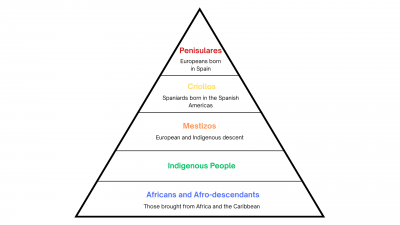
This image shows a colonial social hierarchy, often called the casta system, used in Spanish America to classify people based on their birthplace and ancestry. The pyramid shape represents how power and status were distributed, with those at the top holding the most privilege and those at the bottom having the least.

At the top are Peninsulares, Europeans born in Spain, followed by Criollos, people of Spanish descent born in the Americas. Below them are Mestizos, individuals of mixed European and Indigenous ancestry. Further down are Indigenous peoples, and at the bottom are Africans and Afro-descendants, many of whom were brought through slavery. The diagram highlights how colonial societies were structured around race and origin, reinforcing inequality and limiting social mobility.

Mestizaje as National Ideology

After independence in the 19th century, many Latin American nations rejected rigid caste categories. Instead, intellectuals and political leaders promoted mestizaje the idea that racial mixing defined the nation. 

For example: 

  • In Mexico, thinkers like José Vasconcelos promoted the idea of a “cosmic race” (La Raza Cósmica) that blended all races into a superior future identity. 
  • Governments promoted mestizo identity as modern, unified, and distinct from Europe. 

Mestizaje became a tool for national unity, but also a way to minimize visible racial differences.